Training vs inference: what is the difference?
AI models generally go through two very different kinds of work: training and inference.
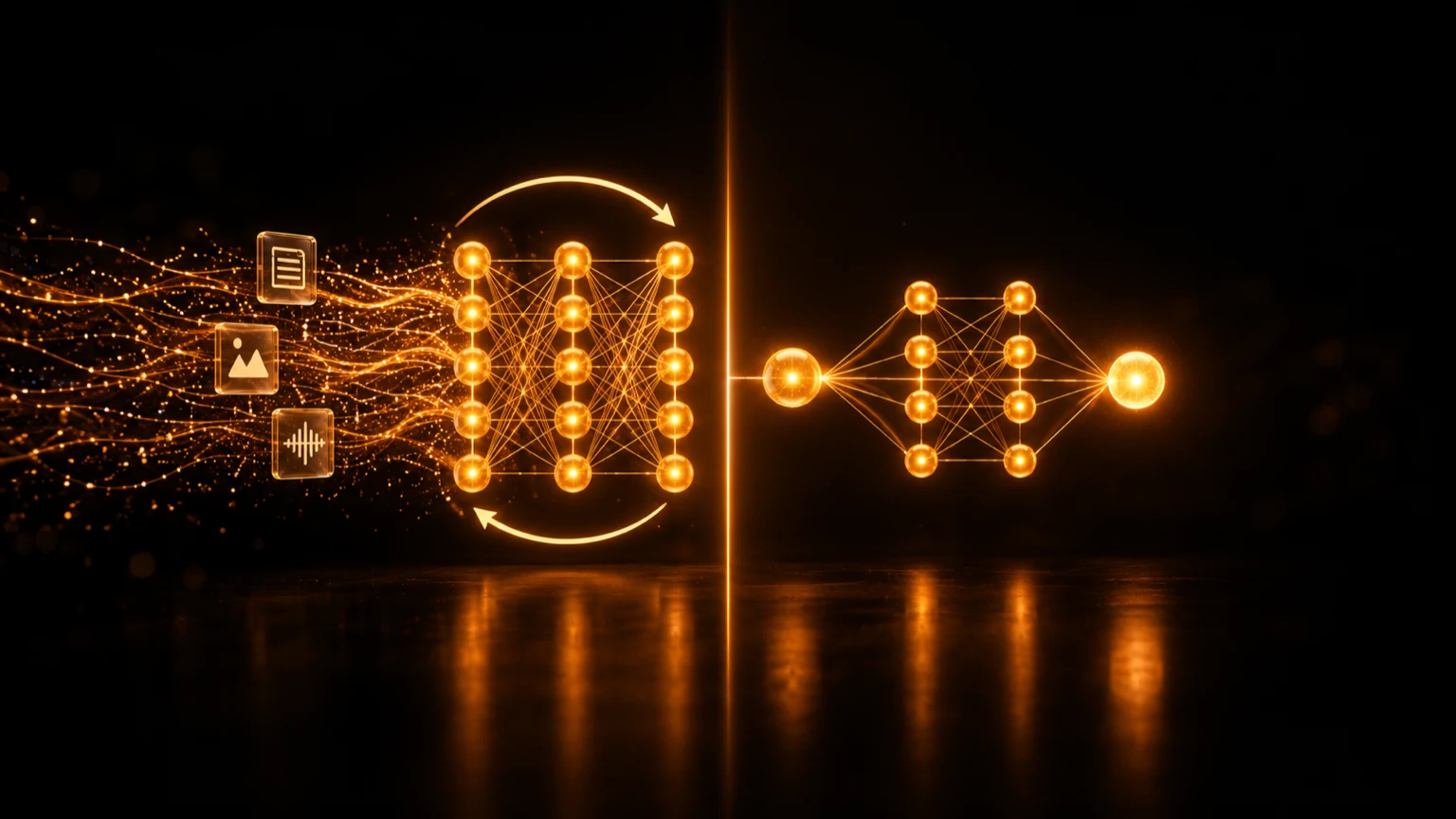
The distinction is simple: training is learning from data, and inference is using what was learned.
During training, a model adjusts its internal parameters so that it becomes better at a task.
During inference, the trained model receives a new input and produces an output without normally changing those learned parameters.
If training is like studying for an exam, inference is like using what you learned to answer a new question.
What happens during training?
Training is the stage where the model learns patterns from data.
Suppose we want to train a model to recognise whether an image contains a cat. At first, its predictions may be poor. It might see a cat and predict only a 20% chance that a cat is present.
The training process compares that prediction with the correct answer and calculates an error, often represented by a quantity called loss.
A simplified training loop looks like this:
- The model receives examples from the training data.
- It makes a prediction.
- The prediction is compared with the correct answer.
- The loss is calculated.
- Backpropagation works out how much each weight contributed to the error.
- The model’s weights are updated.
- The loop repeats.
The important step is the weight update.
A neural network can contain millions or billions of adjustable parameters, usually called weights. Training gradually changes these weights so that the model produces better outputs. We explain loss, weights, and backpropagation in more detail in What is a neural network?
This process may be repeated across a very large dataset, sometimes many times.
What happens during inference?
Inference begins after a model has been trained.
Instead of trying to improve the model, we now want to use it. Show the trained cat model a new image, and it might answer “Cat: 97%”.
The model uses the weights it learned during training to process a new input and return a prediction, classification, generated response, transcription, image, or another result.
In normal inference, there is no backpropagation and no weight update. The input simply moves forward through the trained model’s layers, which is called a forward pass, and comes out as the result.
Every time a chatbot generates an answer, an STT system transcribes new audio, or an image model creates a new picture, the model is performing inference.
Training vs inference at a glance
| Training | Inference | |
|---|---|---|
| Purpose | Teach the model | Use the trained model |
| Input | Training examples | New, real-world input |
| Weights | Updated repeatedly | Normally remain fixed |
| Main computation | Forward pass + backward pass | Forward pass |
| Priority | Learning efficiently and accurately | Responding quickly, reliably, and affordably |
| Typical workload | Large training jobs | Repeated user or application requests |
Both stages may use the same model architecture, but their goals are different.
Why is training usually more computationally demanding?
Training has extra work to do.
The model does not only calculate an output. It also measures the error, propagates information about that error backward through the network, calculates gradients, and updates large numbers of parameters.
Training can therefore require:
- large datasets;
- significant GPU or accelerator compute;
- large amounts of memory;
- repeated passes over data;
- long-running distributed jobs for large models.
For very large AI models, many accelerators may work together. This is why training a model from scratch can be expensive and time-consuming.
However, that does not mean inference is always cheap.
If a model serves millions of requests every day, inference becomes a continuous production workload. Across the lifetime of a popular product, inference can consume enormous computing resources even though one request is much smaller than a complete training run.
What matters during inference?
Inference is where users actually interact with a trained model, so the engineering priorities change.
Important factors often include:
- latency: how quickly one request receives a result;
- throughput: how many requests or tokens the system can process in a period of time;
- memory: whether the model fits efficiently on the available hardware;
- cost: how much each request, token, image, or minute of audio costs to process;
- reliability: whether the system stays stable under real traffic.
For an interactive chatbot, a model that gives an excellent answer but takes a minute to begin responding may provide a poor experience.
For a batch transcription system processing thousands of recordings overnight, slightly higher latency for one file may matter much less than total throughput and cost.
So there is no single “best” inference setup. It depends on the product.
A simple LLM example
Large language models make the difference particularly easy to see.
During training
The model is shown large amounts of text and learns statistical patterns in language. Again and again, it predicts the next token, measures how far the prediction was from the real text, and updates billions of parameters.
Over time, the model’s parameters encode useful patterns about language and the training data.
During inference
A user sends a prompt:
“Explain photosynthesis in two sentences.”
The trained LLM processes the prompt and writes the response one token at a time: each new token is added to the text, and the model predicts the next one until the answer is complete.
The model is applying what it learned during training. It is not normally retraining itself on that prompt.
So simply asking a model a question is inference, not training.
What about fine-tuning?
Fine-tuning is still training.
Instead of training a model from the beginning, developers start with an already trained model and continue training it on new or more specialised data. A general model, trained further on a specialised dataset, becomes a fine-tuned model.
Fine-tuning can adapt a model to a language, domain, style, task, or product requirement.
Once fine-tuning is complete and the updated model is deployed, requests sent to it are again inference.
This is why training, fine-tuning, inference, and deployment should not be treated as interchangeable terms.
A voice-AI example
Voice AI makes the distinction very practical.
Consider a speech-to-text model.
During training, the model may learn from many hours of speech paired with transcripts. Its parameters are adjusted so that it becomes better at mapping audio patterns to text.
During inference, someone records a new voice message. The trained STT model receives the new audio and returns a transcript.
The same idea applies to text-to-speech. A TTS model learns speech patterns during training; later, during inference, it receives new text and generates audio.
At NeuronAI, services such as Speech to Text, Text to Speech, and language-model applications depend on the same separation: models are developed and trained or adapted first, then deployed so that users can run inference on new text or audio.
The user sees the result. Most of the learning happened earlier.
Why can the same model behave differently in production?
Training a good model is only part of building a useful AI product.
Once the model enters inference, the surrounding system matters too.
The same model can have different speed, memory use, and cost depending on factors such as:
- hardware;
- numerical precision;
- batch size;
- inference software;
- model quantisation;
- how requests are scheduled;
- how much context is processed.
For example, quantisation can represent model weights with fewer bits, often reducing memory use and making inference faster or cheaper. The exact quality and performance trade-off depends on the model and method.
This is why AI deployment is an engineering problem of its own. A model can perform well in research tests but still require substantial optimisation before it is practical for thousands of real users.
Does inference mean the model never changes?
Usually, inference itself does not update model weights.
But a production AI system can still improve over time.
Developers may:
- collect new permitted training data;
- evaluate where the model performs poorly;
- train or fine-tune a new version;
- test it;
- deploy the updated model for inference.
Then the loop starts again: inference, evaluation, better data or training, and another round of training.
Training and inference are separate stages, but real AI systems can move through them repeatedly.
The easiest way to remember it
If you remember only one distinction, use this:
Training changes the model. Inference uses the model.
In training, data goes in, the model learns, and its weights are updated. In inference, a new input goes in, the trained weights stay as they are, and an output comes out.
Both are essential.
Without training, the model has not learned the task.
Without inference, the trained model is not actually being used.
Understanding the difference makes many other AI concepts easier to follow, from GPUs and model deployment to fine-tuning, latency, tokens, and the cost of running AI products at scale.